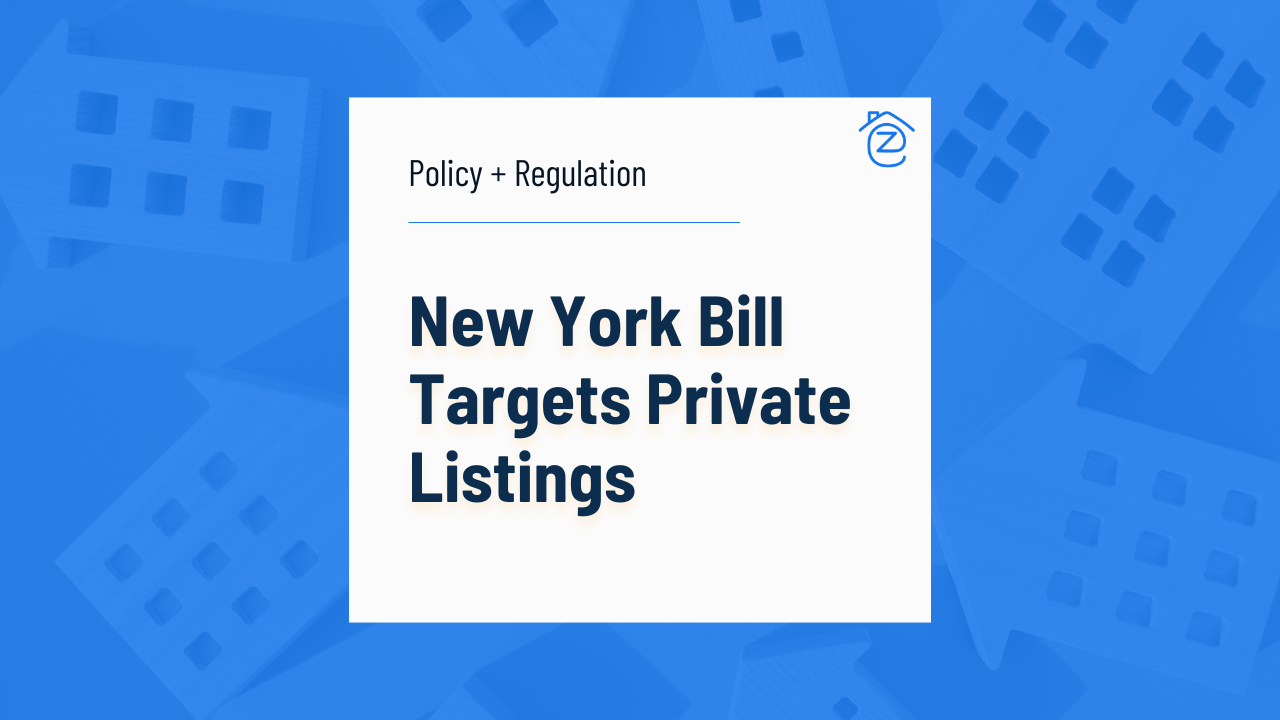
New York is joining a growing national movement to protect consumers and limit hidden home listings.
Washington State recently passed one of the nation’s strictest restrictions on private listings. Wisconsin has already enacted similar transparency rules. Now New York is considering its own version.
The common-thread issue? What must be disclosed to a home seller before they can agree to list their home through a private listing?
On March 20, 2026, Assemblymember Michaelle Solages introduced Assembly Bill A10679, officially titled the Fair and Transparent Real Estate Listings Act. The bill directly targets the growing use of private listings, also called pocket listings, the same practice highlighted in the April 2026 Consumer Federation of America and National Urban League report we covered recently.
How the Bill Would Limit Private Listings
The proposed bill seeks to codify informed consent as a pre-requisite to a private listing.
If passed, the law would require a seller’s agent to publicly advertise or market a residential listing within one calendar day of the listing agreement taking effect, except in limited circumstances where the seller has explicitly opted out.
The bill defines public marketing broadly. The listing has to be made available on at least one publication, platform, or website that is broadly accessible to the general public and to any duly licensed real estate broker or salesperson representing buyers.
That means an agent could not satisfy the rule by marketing the property only through a private listing network or another restricted-access platform.
A seller could still choose a private listing, but only in limited circumstances. One path is a signed state disclosure and opt-out form directing the agent not to publicly market the property. The other is a documented privacy or safety concern, with written acknowledgment of the risks of limited exposure.
Those risks are spelled out in the bill itself: fewer offers, a lower sale price, and a smaller chance for the full market to compete.
Why This Matters for First-Time Buyers
The recent CFA and National Urban League survey found that 46% of housing counselors said first-time buyers are already struggling because of private listings.
That problem starts before a buyer ever writes an offer. A home that never reaches a public search in time can disappear into a smaller circle of brokers, cash buyers, or people with inside access before everyday buyers even know it was available.
That is why this bill matters. It is trying to move more listings into public view early enough for ordinary buyers to actually compete.
What This Bill Gets Right About Transparency
This bill is built around a simple idea: buyers and sellers should not have to rely on hidden networks to find out what homes are available.
That same idea is a core value at EZ Real Estate Platform.
A listing typically works better for all parties when buyers can actually see it, when competition is visible, and when the seller can make decisions with the open market response, instead of behind closed doors.
First-time buyers have a fairer shot at seeing the home and deciding whether to compete. Because of EZ’s flexible buyer premium option, buyers who are stretched thin by down payments or who would need concessions for a deal to work have new ways to negotiate with sellers.
A transparent listing and offer process also helps sellers because wider exposure gives the property a better chance to reach the full buyer pool, create real competition, and discover the price the market is actually willing to pay.
Hidden homes changes more than marketing. It changes who gets a chance to compete and what information is available to consumers and professionals who are tasked with making important decisions.
Try a more transparent way to buy and sell homes:
Search Transparent Homes on EZ → Browse Listings
List Your Home with Full Visibility & 0% Commission → How Listing Works
Related Reading: Private Listings 2026: New Report Shows How Hidden Homes Are Hurting First-Time Buyers →
Note: The opinions, suggestions, and recommendations in this article are for informational purposes only and do not constitute agency or legal advice.